
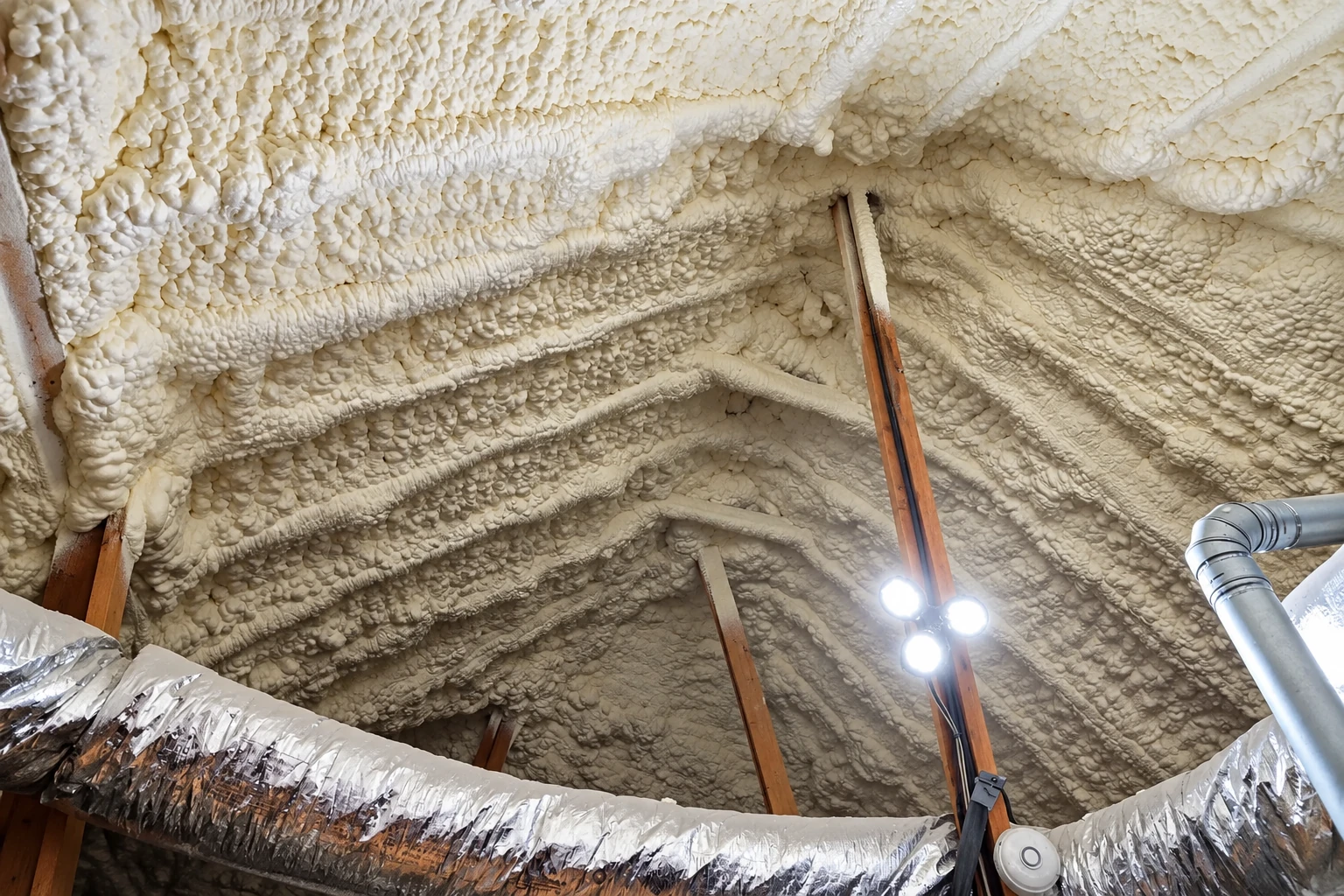
Closed-cell foam insulation in Dallas TX - a sealed attic that keeps moisture out
Upstairs rooms hot and the AC baking in the attic? We spray closed-cell foam under the roof so your ducts sit in cooler air.
Is closed-cell foam the right insulation for your Dallas house?
Closed-cell foam insulation is a dense, rigid spray foam that insulates and blocks nearly all moisture in one layer at the thickness it's usually sprayed, and here in Dallas, TX we mostly put it under roof decks and into walls.
If your AC and ducts live in the attic and the upstairs never cools down, foam under the roof can take the heat off them, though it costs more than sealing the gaps and topping up what's already there. Your price mostly comes down to how much area we cover and how many inches go on, plus whether old insulation has to come out first, whether the walls and ceilings are finished, and how tight the attic is to work in. The schedule turns on your roof, because anything leaking or worn out gets fixed before we spray, and on the time you'll spend away from home while the foam goes in. My written estimate gives you your own number. We're based in Dallas and do this work across the city and the cities around it, and if you're weighing your options, our open-cell foam insulation page covers the softer, lighter foam.
How do you know your house could use closed-cell foam?
Most people don't call asking for closed-cell foam by name. They call because something upstairs or in the attic feels wrong. These are the signs we hear about most around Dallas.
Upstairs bedrooms stay hot all summer, usually because roof heat is soaking into the attic and the ducts.
Your AC unit and ductwork sit in the attic, cooling air in one of the hottest spots in the house.
The room over the garage runs hot in summer and cold in winter, which usually means thin or gapped insulation.
Ducts or framing in the attic look damp or sweaty, a sign humid air is getting in and condensing.
You feel drafts at can lights, outlets or the attic hatch, so outside air is moving straight through.
The power bill jumps every summer even though the AC is fairly new, so cool air is likely leaking out.
If you see water stains on the roof deck or smell something musty up there, call before anyone sprays foam, because that gets fixed first.
What happens after you call us about closed-cell foam?
Here's how a closed-cell foam job runs with us, from your first call to the final walk-through, and who you'll be dealing with at each step.
Call or send a request
Call (214) 706-4099 or use the request form and tell us what's bothering you, whether it's a hot upstairs or a damp attic. We'll set a time for me to come out.
I check the roof first
I look at the attic and walls, and before any foam goes under a roof deck I look at the roof, because spraying under a leak or a roof that's about worn out just makes trouble later. You get a written estimate with your price and anything that has to happen first, like a roof repair or old insulation coming out, so nothing starts until you've seen the number.
Our crew sprays the foam
Our crew preps the space, sprays the foam and cleans up when they're done. You'll be out of the house while they spray, which the questions below cover.
We walk the job together
I walk the finished job with you before we call it done, and you can point at anything you want me to look at. Satisfaction guaranteed.
Get a free written estimate for closed-cell foam
Send the form and we'll get back to you within one business day to set a time. I come out, look at your roof and attic, and leave you a free on-site estimate with no obligation.
- Call
- (214) 706-4099
- Hours
- Mon–Fri: 8 AM–9 PM, Sat–Sun: 6 AM–9 PM
Where closed-cell foam earns its higher price
Closed-cell foam pays off where heat and humidity hit hardest. Under the roof deck, it keeps the Dallas sun off the ducts and the AC unit. In walls, a federal building guide says the ideal wall for hot, humid weather seals air and controls moisture at its outer side, and closed-cell foam does that. On an open attic floor with no ducts above it, it's usually more foam than the job needs.
Thickness is the main choice you'll make with us. Each inch adds the same amount of insulating value, so the number of inches sprayed sets how well it works. Some foams also need a covering, such as a coating or drywall called a thermal or ignition barrier, depending on the foam and the code, though not every foam does, and we sort that out before the job starts.
Rentals and commercial buildings get the same approach. I learned this work doing upkeep in buildings full of tenants, and a lot of what I cleaned up was insulation laid over problems nobody fixed first. Foam over a leak doesn't fix the leak, it just hides it for a while. If you own or manage a building, our commercial insulation work follows the same order, with leaks and roof problems handled before any foam goes on.
Closed-cell foam questions we hear in Dallas
How much does closed-cell spray foam insulation cost in Dallas?
Closed-cell spray foam insulation in Dallas usually costs about $1.10 to $1.60 per board foot, a board foot being one square foot of foam an inch thick. That's the going rate around here, not our quote, and your total depends on how much area gets covered, how deep it's sprayed and the extras covered above, like old insulation coming out. I come out and give you a written estimate with your own number.
Is closed-cell or open-cell foam better under my roof?
Under a roof deck, closed-cell is the one that does both jobs, because it can serve as the insulation and the vapor control layer, the part that keeps moisture from moving through. Open-cell lets vapor pass, so it can't be that layer on its own. Open-cell still has its places, and I'll tell you if your house is one of them.
Do we have to leave the house during spray foam installation?
Yes, you should plan to be out. EPA guidance says anyone not doing the work should leave the home while the foam goes in, worked out with your contractor, and some foam makers recommend 24 hours before people come back, though that time varies by product. We'll go over the re-entry time, when it's safe for you, the kids and the pets to come home, for the foam we're using, so you can book a night away.
Do I need a permit for spray foam insulation in Dallas?
We check with the city's building office before we start, and when your job needs a permit, we handle the application and the inspections. The City of Dallas issues residential permits, its approval to start construction, renovation or major repairs on a home, and every structure has to meet the city's adopted building codes. We're licensed and insured.
How do I know if closed-cell foam is worth it over regular attic insulation?
It's usually worth it when your ductwork and AC unit live in the attic, because foam seals air while it insulates and keeps the attic from cooking them. If the ducts aren't up there, sealing the gaps and topping up loose fill usually does the job for less. I'd rather tell you that than sell you foam you don't need.
What happens to my attic after spray foam goes under the roof deck?
Your attic becomes a sealed space that's heated and cooled along with the rest of the house, so it needs a way to get rid of moisture, and we plan for that before spraying. Any furnace or water heater burning fuel up there should be a direct-vent, sealed-combustion model that takes its air from outside and vents back out. That's why I ask what's burning fuel in your attic before we seal it up.
Other insulation work you might need
Open-cell foam insulation
Open-cell foam is lighter and softer, and it can make sense in walls and other spots where you don't need the foam itself to stop moisture.
Commercial insulation
If you manage rentals, offices or shop buildings, we bring the same foam and the same roof-first approach to commercial jobs, planned around your tenants.
Book a roof and attic check for foam
Call (214) 706-4099 or use the request form, and have your roof's age, how you get into the attic and whether anything up there burns gas handy so I can come out ready.
Mon–Fri: 8 AM–9 PM, Sat–Sun: 6 AM–9 PM